Friday, November 22, 2024

The Seven Great Ecumenical Councils

It's really the beauty of the Seven Ecumenical Councils. They took the Fathers and the Scriptures and reached the conclusions we have today in the Church. The Trinity, the Deity of Christ, the selection of the canon, rejection of iconoclasts, and many others. It was all based on the pattern from the first council in Acts 15 where the church gathered and considered the matter of how Gentils should be received and how they should behave. The leaders of the church decided the matter and the laity agreed. The Church kept that pattern believing it was God's way of determining truth between varying Fathers.

Jesus promised the Spirit to guide His Church into all truth.

The Protestants pick and choose from among these councils the things they agree with and the things they disagree with. 


Lists of Apostles

Similarities and Differences in the lists of the names of the Apostles

Matthew and Mark have the same names, in a different order to each other, and with some different details.

The Synoptic Gospels match for the most part, but Luke has a different name for one of the apostles compared to Matthew and Mark. 

  • Matthew and Mark have Thaddaeus
  • Luke has Judas the brother of James
Luke and Acts have the same list of names but considering they are both authored by Luke this should not be a surprise. 

Gospel Source Materials (KJV)

Mat 10:2-3 Now the names of the twelve apostles are these; The first, Simon, who is called Peter, and Andrew his brother; James the son of Zebedee, and John his brother; Philip, and Bartholomew; Thomas, and Matthew the publican; James the son of Alphaeus, and Lebbaeus, whose surname was Thaddaeus; Simon the Canaanite, and Judas Iscariot, who also betrayed him.

Mar 3:16-19 And Simon he surnamed Peter; And James the son of Zebedee, and John the brother of James; and he surnamed them Boanerges, which is, The sons of thunder: And Andrew, and Philip, and Bartholomew, and Matthew, and Thomas, and James the son of Alphaeus, and Thaddaeus, and Simon the Canaanite, And Judas Iscariot, which also betrayed him...

Luk 6:14-16 Simon, (whom he also named Peter,) and Andrew his brother, James and John, Philip and Bartholomew, Matthew and Thomas, James the son of Alphaeus, and Simon called Zelotes, And Judas the brother of James, and Judas Iscariot, which also was the traitor.

Act 1:13 And when they were come in, they went up into an upper room, where abode both Peter, and James, and John, and Andrew, Philip, and Thomas, Bartholomew, and Matthew, James the son of Alphaeus, and Simon Zelotes, and Judas the brother of James.


Interesting Fifth Century Amulet

 An interesting fifth century object was found in Turkey.

The object was interpreted by the Turkish archaeological authorities as King Solomon which Islam sees as Prophet Solomon.

"The depiction of Prophet Solomon on this necklace surprised us and revealed the importance of the artifact for Anatolian archaeology," said Çelikbaş. Anatolia is a region of Turkey. 5th-century amulet depicting biblical figure King Solomon spearing the devil discovered in Turkey

I am certainly no expert on pieces like this but it seems a lot more like Saint George and the dragon than King Solomon.


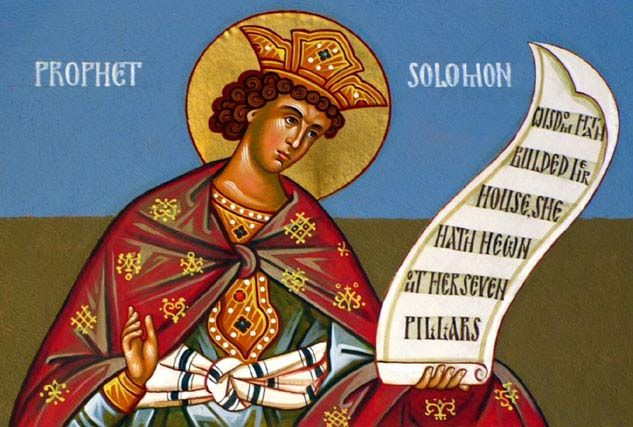
Solomon is considered a Prophet-King by the Eastern Orthodox. His commemoration date is Dec 12 (Prophet Solomon).\

The Prophet-King Solomon (ca. 972 - 932 B.C.) was the son of David and Bathsheba. He succeeded his father as King and reigned for forty years. He built the palace and the Temple at Jerusalem, and was renowned for his wisdom. The Old Testament books of Proverbs, the Song of Songs, and the Wisdom of Solomon are attributed to him. He may have written parts of these books, but much of the material was probably transmitted orally before it was written down.

In the Gospels, Christ mentions Solomon by name, citing his glory and wisdom (Matthew 6:29; 12:42).

Solomon is not considered a Saint perhaps due to his lifestyle but he's still considered a Prophet because he produced the above Biblical materials.


Saints for 2024-11-22

The Saints for today:

  • Archippus the Apostle, Philemon the Apostle & his wife, Apphia, Onesimos the Disciple of Paul (Today's Epistle reading)
  • Holy Martyr Cecilia and those with her,
  • Afterfeast of the Entry of the Theotokos into the Temple
  • Kallistos Xanthopoulos, Patriarch of Constantinople
  • Anthimos, President of Crete
  • Righteous Jacob of Evia

Archippus

According to the 4th century Apostolic Constitutions (7.46), Archippus was the first bishop of Laodicea in Phrygia (now part of Turkey). Another tradition states that he was one of the 72 disciples appointed by Jesus Christ in Luke 10:1. The Roman Catholic Church observes a feast day for Saint Archippus on March 20. The Eastern Orthodox Church observes a feast day on February 19 as well as November 22 along with Saints Philemon, Apphia, and Onesimus. According to tradition, he was stoned to death. (Wikipedia)


Saint Cecilia

Saint Cecilia (Latin: Sancta Caecilia), also spelled Cecelia, was a Roman Christian virgin martyr, who is venerated in Catholic, Orthodox, Anglican, and some Lutheran churches, such as the Church of Sweden.[2] She became the patroness of music and musicians, it being written that, as the musicians played at her wedding, Cecilia "sang in her heart to the Lord". Musical compositions are dedicated to her, and her feast, on 22 November, is the occasion of concerts and musical festivals. She is also known as Cecilia of Rome. (Wikipedia)


Nikephoros Kallistos Xanthopoulos

Nikephoros Kallistos Xanthopoulos (Greek: Νικηφόρος Κάλλιστος Ξανθόπουλος; Latinized as Nicephorus Callistus Xanthopulus;[1] c. 1256 – 1335) was a Greek ecclesiastical historian and litterateur of the late Byzantine Empire.[2] His most popular work, the voluminous Ecclesiastica historia, constitutes a significant documentary source on primitive Christianity and its doctrinal controversies, as well as for hagiographical, liturgical, and legendary texts from Byzantine culture. (Wikipedia)


Anthimos President of Crete

He was born in Crete, at the beginning of the 14th century. For reasons which we do not know, he found himself in Athens, where he was appointed Metropolitan of the then insignificant Metropolis of Athens and Euripus (Evia), shepherding between the years 1339-1366.

In order to complete their work, the Cretan rebels asked the Ecumenical Patriarchate to send them an Orthodox Metropolitan. They even asked for their compatriot Anthimos. The Ecumenical Patriarchate responded positively to their request and in 1366, sent Anthimos to Crete, appointing him President of the Metropolis of Crete, appreciating him for his holiness, his love for the Church and his confessional attitude.

It is well worth reading the account of the tortures he received at the hands of the Latins (Orthodox Christianity Then and Now).

Righteous Jacob of Evia

The venerable Elder Iakovos Tsalikes, the admirable Abbot of the Monastery of the Venerable David in Evia, was a long-range star who shined in our days with the rays of his simplicity, his goodness, his equal-to-the-angels state and his numerous wonders.

Elder Iakavos was the personification of love, a living embodiment of "the new life in Christ", a projector of virtue and a mirror of humility and temperance.  (Orthodox Christianity Then and Now).


The Elect One

There's an Old Testament prophecy in the book of Isaiah that is a prophecy of the Messiah.

Isaiah 42:1 Behold my servant, whom I uphold; mine elect, in whom my soul delighteth; I have put my spirit upon him: he shall bring forth judgment to the Gentiles.

The Messiah is the Elect One. This theme is carried farther in Isaiah.

Isaiah 65:9 And I will bring forth a seed out of Jacob, and out of Judah an inheritor of my mountains: and mine elect shall inherit it, and my servants shall dwell there.

 Those who are in Christ are in the Elect One and can be numbered in the Elect.

Gospel Reading 2024-11-22

LUKE 19:12-28 The Lord said this parable, "A nobleman went into a far country to receive a kingdom and then return. Calling ten of his servants, he gave them ten pounds, and said to them, 'Trade with these till I come.' But his citizens hated him and sent an embassy after him, saying, 'We do not want this man to reign over us.' When he returned, having received the kingdom, he commanded these servants, to whom he had given the money, to be called to him, that he might know what they had gained by trading. The first came before him, saying, 'Lord, your pound has made ten pounds more.' And he said to him, 'Well done, good servant! Because you have been faithful in a very little, you shall have authority over ten cities.' And the second came, saying, 'Lord, your pound has made five pounds.' And he said to him, 'And you are to be over five cities.' Then another came, saying, 'Lord, here is your pound, which I kept laid away in a napkin; for I was afraid of you, because you are a severe man; you take up what you did not lay down, and reap what you did not sow.' He said to him, 'I will condemn you out of your own mouth, you wicked servant! You knew that I was a severe man, taking up what I did not lay down and reaping what I did not sow? Why then did you not put my money into the bank, and at my coming I should have collected it with interest?' And he said to those who stood by, 'Take the pound from him, and give it to him who has the ten pounds.' (And they said to him, 'Lord, he has ten pounds!') 'I tell you, that to every one who has will more be given; but from him who has not, even what he has will be taken away. But as for these enemies of mine, who did not want me to reign over them, bring them here and slay them before me.'" And when he had said this, he went on ahead, going up to Jerusalem.

God sent prophets to the Hebrews and the Hebrews killed the prophets.

Matthew 23:29-32 Woe unto you, scribes and Pharisees, hypocrites! because ye build the tombs of the prophets, and garnish the sepulchers of the righteous, And say, If we had been in the days of our fathers, we would not have been partakers with them in the blood of the prophets. Wherefore ye be witnesses unto yourselves, that ye are the children of them which killed the prophets. Fill ye up then the measure of your fathers.

God sent His Only Son to the Hebrews. They killed Him, too. After His Ascension Christ entered Glory and Seating at the Right Hand of God where Christ received his kingdom. We are now waiting on the King to return and judge the world.

In the meanwhile, we in Christ's Church are to be faithful to the ministry Christ left us. After his ministry Christ committed the work of the ministry to His Church. They/we were responsible to faithful with what they were given.

1 Corinthians 10:6-12 Now these things were our examples, to the intent we should not lust after evil things, as they also lusted. Neither be ye idolaters, as were some of them; as it is written, The people sat down to eat and drink, and rose up to play. Neither let us commit fornication, as some of them committed, and fell in one day three and twenty thousand. Neither let us tempt Christ, as some of them also tempted, and were destroyed of serpents. Neither murmur ye, as some of them also murmured, and were destroyed of the destroyer. Now all these things happened unto them for ensamples: and they are written for our admonition, upon whom the ends of the world are come. Wherefore let him that thinketh he standeth take heed lest he fall.

Jesus is warning His Church to not fail, as the Hebrews did.

Epistle Reading 2024-11-22

ST. PAUL'S LETTER TO PHILEMON 1:1-25

PAUL, a prisoner for Christ Jesus, and Timothy our brother, To Philemon our beloved fellow worker, and Apphia our sister and Archippos our fellow soldier, and the church in your house: Grace to you and peace from God our Father and the Lord Jesus Christ. I thank my God always when I remember you in my prayers, because I hear of your love and of the faith which you have toward the Lord Jesus and all the saints, and I pray that the sharing of your faith may promote the knowledge of all the good that is ours in Christ. For I have derived much joy and comfort from your love, my brother, because the hearts of the saints have been refreshed through you. Accordingly, though I am bold enough in Christ to command you to do what is required, yet for love's sake I prefer to appeal to you - I, Paul, an ambassador and now a prisoner also for Christ Jesus - I appeal to you for my child, Onesimos, whose father I have become in my imprisonment. (Formerly he was useless to you, but now he is indeed useful to you and to me.) I am sending him back to you, sending my very heart. I would have been glad to keep him with me, in order that he might serve me on your behalf during my imprisonment for the gospel; but I preferred to do nothing without your consent in order that your goodness might not be by compulsion but of your own free will. Perhaps this is why he was parted from you for a while, that you might have him back for ever, no longer as a slave but more than a slave, as a beloved brother, especially to me but how much more to you, both in the flesh and in the Lord. So if you consider me your partner, receive him as you would receive me. If he has wronged you at all, or owes you anything, charge that to my account. I, Paul, write this with my own hand, I will repay it - to say nothing of your owing me even your own self. Yes, brother, I want some benefit from you in the Lord. Refresh my heart in Christ. Confident of your obedience, I write to you, knowing that you will do even more than I say. At the same time, prepare a guest room for me, for I am hoping through your prayers to be granted to you. Epaphras, my fellow prisoner in Christ Jesus, sends greetings to you, and so do Mark, Aristarchos, Demas, and Luke, my fellow workers. The grace of the Lord Jesus Christ be with your spirit. Amen.

It's not often we get an entire book as the reading of the day. The Epistle reading for today is about two of the saints for today.

Archippus the Apostle, Philemon the Apostle & his wife, Apphia, Onesimos the Disciple of Paul, Holy Martyr Cecilia and those with her, Afterfeast of the Entry of the Theotokos into the Temple, Kallistos Xanthopoulos, Patriarch of Constantinople, Anthimos, President of Crete, Righteous Jacob of Evia

It tells the story of a slave who escaped his master and ended up with Paul. He was helpful to Paul since Paul was imprisoned at the time and needed food, etc.

Paul sends him back to his master with this letter and entreats his master to receive him back as a fellow servant of Christ and no longer as a slave.

This book was influential in the movement to abolish slavery (Christian abolitionism).

In the fourth century, the bishop Gregory of Nyssa articulated a fundamentally Christian conception of the world that embedded a thorough rejection of the notion that one human could be owned by another and a condemnation of the institution of slavery.


Web Resources on the Church Fathers and the Bible

Helpful Study Resources

This list should grow with time but here's a start with the tools I'm using presently.

Philip the Evangelist was one of the Seven Deacons

The Apostles in Jerusalem Selected Seven Deacons

There are two Philips in the Book of Acts. One of them is Philip who is one of the 12 apostles. The other Philip was selected as one of the seven Deacons in Acts 6. 

Act 6:5 And the saying pleased the whole multitude: and they chose Stephen, a man full of faith and of the Holy Ghost, and Philip, and Prochorus, and Nicanor, and Timon, and Parmenas, and Nicolas a proselyte of Antioch:

Of minor note, the first two names are the only ones which have any information about them beyond this Acts 6:5 passage. Stephen is of note as the first martyr of the church and Philip's evangelistic activities are covered in Acts.

Acts 8 shows the evangelistic acts of Philip including Philip speaking with the Ethiopian Eunuch. 

Philip AKA Philip the Evangelist was one of the seven deacons

Acts 21 lets one separate out Philip the Deacon/Evangelist from Philip the Apostle

Act 21:8 And the next day we that were of Paul's company departed, and came unto Caesarea: and we entered into the house of Philip the evangelist, which was one of the seven; and abode with him.


Thursday, November 21, 2024

Sola Fide

"Orthodoxy abhors theological innovation and Luther did two things at the same time; he committed heresy by introducing a theological innovation and he committed schism by rejecting those who did not hold to sola fide, e.g., the early church fathers and the Orthodox Church."

"The issue here is not Pelagianism or Semi-Pelagianism.  The real issue between classical Protestantism and Orthodoxy is monergism versus synergism.  The Orthodox Church unabashedly affirms the synergistic understanding of salvation in Christ: God in his grace reaches out to us and we respond to God’s initiative."

Response to Theodore – Semi-Pelagianism, Sola Fide, and Theosis

Conditions for Salvation?


How is someone saved?

Luke 8:12 Those by the way side are they that hear; then cometh the devil, and taketh away the word out of their hearts, lest they should believe and be saved.

Matthew 24:13 But he that shall endure unto the end, the same shall be saved.

Mark 16:16 He that believeth and is baptized shall be saved; but he that believeth not shall be damned.

Acts 2:21 And it shall come to pass, that whosoever shall call on the name of the Lord shall be saved.

Acts 4:12 Neither is there salvation in any other: for there is none other name under heaven given among men, whereby we must be saved.

Acts 15:11 But we believe that through the grace of the Lord Jesus Christ we shall be saved, even as they.

Acts 16:31 And they said, Believe on the Lord Jesus Christ, and thou shalt be saved, and thy house.

Romans 5:9 Much more then, being now justified by his blood, we shall be saved from wrath through him.

Romans 10:9 That if thou shalt confess with thy mouth the Lord Jesus, and shalt believe in thine heart that God hath raised him from the dead, thou shalt be saved.

1 Corinthians 15:2 By which also ye are saved, if ye keep in memory what I preached unto you, unless ye have believed in vain.

Ephesians 2:5 Even when we were dead in sins, hath quickened us together with Christ, (by grace ye are saved;)

Ephesians 2:8 For by grace are ye saved through faith; and that not of yourselves: it is the gift of God:

1 Timothy 2:4 Who will have all men to be saved, and to come unto the knowledge of the truth.

2 Peter 3:9 The Lord is not slack concerning his promise, as some men count slackness; but is longsuffering to us-ward, not willing that any should perish, but that all should come to repentance.


Orthodox Apologetics Calvinism V. Arminianism


Cherry Picking the Fathers

Great post on Evangelicals cherry picking of the Church Fathers: Does Theological Retrieval Work?

Gavin Ortlund’s switch to the Baptist tradition based on his personal study is a good example of theology as a self-constructed project (See Ortlund 2013). Herein lies the methodological divide between Protestantism and Eastern Orthodoxy. In Orthodoxy, one receives the Faith from the Church and one does theology within the context of the Church. In Protestantism, one constructs theology based upon one’s careful study of the Bible.

Epistle Reading 2024-11-21

Hebrews 9:1-7 Now the first covenant had regulations for worship and also an earthly sanctuary. A tabernacle was set up. In its first room were the lampstand and the table with its consecrated bread; this was called the Holy Place. Behind the second curtain was a room called the Most Holy Place, which had the golden altar of incense and the gold-covered ark of the covenant. This ark contained the gold jar of manna, Aaron’s staff that had budded, and the stone tablets of the covenant. Above the ark were the cherubim of the Glory, overshadowing the atonement cover. But we cannot discuss these things in detail now. When everything had been arranged like this, the priests entered regularly into the outer room to carry on their ministry. But only the high priest entered the inner room, and that only once a year, and never without blood, which he offered for himself and for the sins the people had committed in ignorance.

Here's the writer of Hebrews describes the temple and its practices. He places these things within the "First Covenant".

There was a promise in the Old Testament that this covenant would be replaced with a New Covenant. 

Jeremiah 31:31 “The days are coming,” declares the LORD, “when I will make a new covenant with the people of Israel and with the people of Judah.

New Testament refers to the old covenant and shows that there is a New Covenant.

Hebrews 8:8 But God found fault with the people and said: “The days are coming, declares the Lord, when I will make a new covenant with the people of Israel and with the people of Judah.

Hebrews 8:6 But in fact the ministry Jesus has received is as superior to theirs as the covenant of which he is mediator is superior to the old one, since the new covenant is established on better promises.

He has shown from the Priest, from the Priesthood, from the Covenant, that that [dispensation] was to have an end. From this point he shows it from the fashion of the tabernacle itself. How? This, he says, [was] the Holy and the Holy of Holies. The holy place then is a symbol of the former period (for there all things are done by means of sacrifices); but the Holy of Holies of this that is now present. And by the Holy of Holies he means Heaven; and by the veil, Heaven, and the Flesh enters into that within the veil: that is to say, through the veil of His flesh. Supra, 6:19; Hebrews 10:20 And it were well to speak of this passage, 
John Chrysostom AD 407

Gospel Reading 2024-11-21

Luke 10:38-42, 11:27-28 As Jesus and his disciples were on their way, he came to a village where a woman named Martha opened her home to him. She had a sister called Mary, who sat at the Lord’s feet listening to what he said. But Martha was distracted by all the preparations that had to be made. She came to him and asked, “Lord, don’t you care that my sister has left me to do the work by myself? Tell her to help me!” “Martha, Martha,” the Lord answered, “you are worried and upset about many things, but few things are needed—or indeed only one. Mary has chosen what is better, and it will not be taken away from her.” ... As Jesus was saying these things, a woman in the crowd called out, “Blessed is the mother who gave you birth and nursed you.” He replied, “Blessed rather are those who hear the word of God and obey it.”

The Fathers:

Mary came and sat at his feet. This was as though she were sitting on firm ground at the feet of him who had forgiven the sinful woman her sins. She had put on a crown in order to enter into the kingdom of the Firstborn. She had chosen the better portion, the Benefactor, the Messiah himself. This will never be taken away from her. Martha’s love was more fervent than Mary’s, for before he had arrived there, she was ready to serve him. “Do you not care that my sister has left me to serve alone?” When he came to raise Lazarus to life, she ran and came out first. 
Commentary on Tatian’s Diatessaron. Ephrem The Syrian AD 373

and

Virtue does not have a single form. In the example of Martha and Mary, there is added the busy devotion of the one and the pious attention of the other to the Word of God, which, if it agrees with faith, is preferred even to the very works, as it is written: “Mary has chosen the good portion, which shall not be taken away from her.” So let us also strive to have what no one can take away from us, so that not careless but diligent hearing may be granted to us. For even the seeds of the heavenly Word itself are likely to be taken away if they are sowed by the wayside. Let the desire for wisdom lead you as it did Mary. It is a greater and more perfect work. Do not let service divert the knowledge of the heavenly Word…. Nor is Martha rebuked in her good serving, but Mary is preferred because she has chosen the better part for herself, for Jesus abounds with many blessings and bestows many gifts. And therefore the wiser chooses what she perceives as foremost. 
Ambrose of Milan AD 397


The Epistle of Ignatius to the Trallians - Early Church Structure

In Ignatius Chapter 8:

He that is within the altar is pure, but he that is without is not pure; that is, he who does anything apart from the bishop, and presbytery, and deacons, such a man is not pure in his conscience.

 The Letters of Ignatius are very early. Hisg seven epistles preserved under the name of Ignatius are generally considered authentic, since they were mentioned by the historian Eusebius in the first half of the fourth century. 

We see the same structure in the early church that we see today.

Some Protestants have tended to deny the authenticity of all the epistles because they attest to a monarchical episcopate in the second century. 


Sufficiency of Scripture?

Missing Books?

In Saint Paul's letter to the Corinthians (called 1 Corinthians in our Bibles), Paul refers to a previous letter. This letter is no longer existent (as far as anyone knows).

1 Corinthians 5:9 I wrote to you in my letter not to associate with sexually immoral people...

Paul refers to a letter to The Laodiceans as well. This letter may be the one referred to as Ephesians (OSB notes on Col 4:14 suggest this possibility due to geographics proximity between the two cities).

Colossians 4:16 After this letter has been read to you, see that it is also read in the church of the Laodiceans and that you in turn read the letter from Laodicea.

These missing letters have never been an issue to the Historical Churches. It did not escape their notice that there were missing letters, but it was not of any particular concern. For the Historical Churches the Scriptures were not the sole deposit of the faith so nothing was missing when the books were lost.

Gathering of the Epistles into a Collection

By this historical construction (The Lost Letters of Saint Paul, and How They Were Lost in Patheos) the Epistles of Paul were not even gathered together and quoted by the Fathers until the Second Century. Note: I think this is an entirely reasonable reconstruction but have not looked at the account of the Fathers for their account of the collection of the Epistles of Paul.

This paper puts the collection of the Epistles as either 150 or 180 AD. In any event, the letters of Paul as a corpus would have been unavailable as a collection to the first six or so generations of Christians. There is simply no way that the early Church was founded around the collection of the writings of Paul.

The collection of letters became our Pauline epistles [sic: and are now] in the New Testament. From the second century, people start valuing and quoting these rediscovered letters.

Orthodox Church View of the Scriptures

It is the faith of the Orthodox Church that the Church alone possesses the fullness of the faith and that the faith is found in Holy Tradition - which includes Holy Scripture. A missing book or two (perhaps as many as hundreds or more missing books per the Patheos link above) isn't an issue for the Orthodox Church. It's just a historical footnote.

Critiques of the Protestant View

Protestants hold a vastly different idea of Scripture, the idea of the "sufficiency of scripture". This is an extra-Biblical tradition.

Scripture is sufficient in that it is the only inspired, inerrant, and therefore final authority for Christians for faith and godliness, with all other authorities being subservient to Scripture. The Sufficiency of Scripture,

Missing books are much more serious concern for the Protestant approach to church authority since they imply a missing part of the revelation. Some attempts to explain these issues with a notion that Paul may have made some error in those other letters so they were not preserved. This and other explanations are entirely ad hoc.


Wednesday, November 20, 2024

Human Letters Were Written in Hearts Before Written Letters

The Apostle Paul wrote this second letter to the Church at Corinth. Paul’s first visit to Corinth had previously occurred during his second missionary journey and lasted for almost two years (50-52 A.D.) ref: Paul's Visits and Letters to Corinth. In the letter Paul describes the Church there are the product of his preaching. 

2 Corinthians 3:1-3 Are we beginning to commend ourselves again? Or do we need, like some people, letters of recommendation to you or from you? You yourselves are our letter, written on our hearts, known and read by everyone. You show that you are a letter from Christ, the result of our ministry, written not with ink but with the Spirit of the living God, not on tablets of stone but on tablets of human hearts.

Paul is quite explicit here in declaring that the Church in Corinth was not a product of written Scriptures but a product of his preaching and that of others to the Corinthians. The notion of the church being formed from the writings of Paul is completely foreign to the New Testament and is a Reformation novelty. It is historically absurd. The Reformers used their novel teachings as a pretext to undermine the authority of the Historical Churches.

Gospel Reading 2024-11-20

Luke 18:15-17;, 26-30   And they brought unto him also infants, that he would touch them: but when his disciples saw it, they rebuked them. But Jesus called them unto him, and said, Suffer little children to come unto me, and forbid them not: for of such is the kingdom of God. Verily I say unto you, Whosoever shall not receive the kingdom of God as a little child shall in no wise enter therein. ... And they that heard it said, Who then can be saved? And he said, The things which are impossible with men are possible with God. Then Peter said, Lo, we have left all and followed thee. And he said unto them, Verily I say unto you, There is no man that hath left house, or parents, or brethren, or wife, or children, for the kingdom of God's sake, Who shall not receive manifold more in this present time, and in the world to come life everlasting.

Aligning our lives with God and His Kingdom will set us at odds with family members. The Kingdom is very demanding. It calls us to put God above all others in our lives. The important thing it to ensure that we are lining up with God and not a false religion which pretends to be of God.

We are to receive the Kingdom as little children, infants in fact in the text. Infants are wholly dependent on their parents for everything in their lives. So too are we to be dependent on God for everything related to our lives.


Epistle Reading 2024-11-20

Colossians 3:17-25, 4:1 And whatsoever ye do in word or deed, do all in the name of the Lord Jesus, giving thanks to God and the Father by him. Wives, submit yourselves unto your own husbands, as it is fit in the Lord. Husbands, love your wives, and be not bitter against them. Children, obey your parents in all things: for this is well pleasing unto the Lord. Fathers, provoke not your children to anger, lest they be discouraged. Servants, obey in all things your masters according to the flesh; not with eyeservice, as menpleasers; but in singleness of heart, fearing God: And whatsoever ye do, do it heartily, as to the Lord, and not unto men; Knowing that of the Lord ye shall receive the reward of the inheritance: for ye serve the Lord Christ. But he that doeth wrong shall receive for the wrong which he hath done: and there is no respect of persons. Masters, give unto your servants that which is just and equal; knowing that ye also have a Master in heaven.

In this passage, the Apostle Paul lays out a structure for the family based on both hierarchy and reciprocity of relations.

The charge to wives is different than the charge given to husbands. Wives are to submit to their husbands and husbands are to love their wives. This language reflects hierarchy and mutuality.

Some might ask, "What if my husband doesn't obey Christ?" Peter addresses this in another place.

1 Peter 3:1 Likewise, ye wives, be in subjection to your own husbands; that, if any obey not the word, they also may without the word be won by the conversation of the wives;

This is a hard word for many women. The command to a husband to love his wife is equally hard.

All things are to be done under the headship of Christ because we all serve Christ.

We are called to do what we do as to the Lord. 


Moving BLOG...

 Picking up here .